A few flowers stand in a white vase. Vertical ribs catch the light, turning a simple cylinder into a surface with depth and rhythm. The form is recognizable, even before you learn where it came from.
The Lyngby vase gives us a clear way into the story of Lyngby Porcelæn. Its character comes from the relationship between shape, surface, and use. Behind that familiar object is the history of a Danish factory, a period of disappearance, and an archive that has found new ways to belong in contemporary homes.
From a Sugar Refinery to the Danish Table
Lyngby Porcelæn began in 1936 as Porcelænsfabrikken Danmark in Kongens Lyngby. The wholesaler Holst & Knudsen established the factory in a former sugar refinery close to Lyngby Station. The business produced tableware, vases, and decorative objects, using modern equipment to develop a substantial porcelain operation.
The setting is an interesting part of the story. A building associated with one industry became the place where a different material entered Danish daily life. The railway location connected a local factory with a much wider market.
According to the Lyngby-Taarbæk municipal archive, the factory employed around 500 people and, at its peak, accounted for about a third of Denmark’s porcelain production. Those figures help explain how its designs became familiar across households. This was a significant industrial business as well as a source of objects we now appreciate for their design.
The archive also records the introduction of the heat-resistant Dan-ild series in 1956. Its dishes could move from oven to dining table, connecting preparation and serving through the same object. That practical idea gives another perspective on the company’s legacy: porcelain could make a household task simpler while contributing to the appearance of the meal.
The industrial setting also helps explain why household design can carry collective memories. A factory producing objects in large numbers sends the same forms into many different lives. One family associates a dish with weekend meals; another remembers a vase on a relative’s table. Years later, the same recognizable shape can connect those separate memories. The object’s history includes both the place where it was made and the homes where it became familiar.

Lyngby porcelain design
A Vase Whose Shape Carries the Story
The ribbed Lyngby vase expresses a particular approach to porcelain. The cylindrical outline is straightforward, and the repeating vertical relief supplies its identity. Decoration becomes part of the shape itself.
The official brand history places the vase within a wider shift toward form and function in porcelain design. The original factory’s modern production methods helped make that approach possible, and the vase became one of its enduring designs.
The ribs also change how the object is experienced. Light touches their raised edges and settles into the narrow recesses. Turn the vase, move it to another shelf, or let daylight change, and the same surface offers a different pattern of shadow.
Flowers add another layer. A loose arrangement gives the vase a relaxed appearance; a few carefully chosen stems make its geometry more prominent. The object provides a clear structure while the contents contribute movement, color, and variation.
That balance makes the design unusually easy to understand. The vase has a distinct personality on its own and still gives the flowers room to become the focus. You can appreciate it as a piece of porcelain and use it without having to arrange an entire room around it.

Rhombe Color mug
The Return of a Design Archive
The original factory closed in 1969, and the Lyngby vase went out of production. Interest in the design continued during the decades that followed. In 2012, the Lyngby Porcelæn brand was revived and production of the vase resumed. Rosendahl Design Group acquired the brand in 2016.
Rhombe is one of the clearest examples. Its repeating diamond pattern comes from a design in Lyngby’s 1961 archive. In contemporary tableware, that detail becomes a tactile relief, bringing a historical pattern into the surfaces of cups, bowls, and plates.
Rhombe Color adds another interpretation. The palette was developed with Stilleben, the design duo of Ditte Reckweg and Jelena Schou Nordentoft. Their use of color gives the established tableware a different energy, allowing individual pieces to work together through contrast as well as similarity.
The archive supplies a starting point, and the designers give it a contemporary setting. A relief that once belonged to a historical collection can take on another character when it appears in a vivid shade. Its origins remain part of the object, while the experience belongs to the present.
That is a productive way to think about a revival. Returning a classic to production makes one chapter accessible again. Working with the archive creates the possibility of new chapters, with different designers, materials, and everyday uses contributing to the story.

Rhombe Color tableware
History You Can Hold in Your Hands
Lyngby’s design language continues through collections with their own identities. Philip Bro Ludvigsen’s Tura designs, for example, explore a more sculptural approach to the vase and other porcelain objects. The brand’s designer profile identifies him with the Tura collection and its broader interest in form.
The connection between these pieces is easy to feel. Vertical ribs, diamond reliefs, and shaped porcelain surfaces give otherwise familiar household objects another dimension. You encounter the detail by picking up a cup, setting a plate down, or moving a vase into the light.
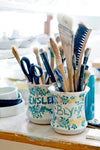
Rhombe Color offers a particularly approachable way to make those details personal. A blue mug can sit beside a white plate, while another shade introduces a new relationship at the table. The official collection encourages combinations across the Rhombe family, including classic white pieces and colored interpretations.
That flexibility suits the way a table evolves over time. People bring together dishes they have chosen, inherited, or received as gifts. A consistent relief or form can provide a connection between pieces while leaving room for differences in color.
The objects can take part in ordinary occasions as easily as more considered settings. A morning coffee is enough to appreciate the surface of a mug. A few flowers give the vase its purpose. The design history arrives through a useful object and becomes part of a familiar activity.
At BrandsWalk, we are drawn to that direct relationship between heritage and daily use. Lyngby’s story includes a factory, a pause, a revival, and continuing creative work. You do not need to know every date to enjoy a piece, but learning the history makes its details more meaningful.
Look again at the ribs on a vase or the pattern around a cup. A simple object begins to reveal the decisions, materials, and people behind it. Then you fill it, use it, and give that history a place in your own home.

Rhombe Color on the table